

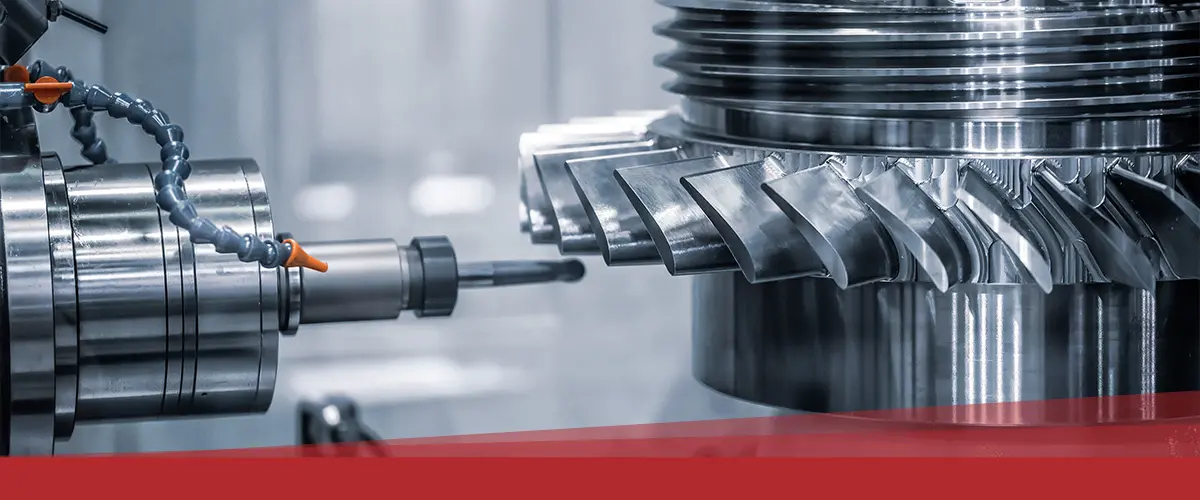
In aerospace machining, OEMs need to achieve high-speed, high-precision performance, often at 30,000 RPM or higher, on machines that cut titanium, composites, and other difficult materials to flawless standards.
The path to faster revolutions per minute isn’t as simple as ramping up the spindle. Feed rate, tool integrity, and part quality all hinge on interdependent factors that must be engineered in harmony. Simply increasing speed without addressing the complexities of the system’s thermal, mechanical, and dynamic stability factors leads not to productivity, but to failure.
Let’s explore evolving requirements of aerospace machining and three fundamental spindle engineering challenges that must be solved to deliver true, reliable high-speed machining for aerospace applications. Mastering these challenges de-risks machine tool projects and protects the reputations and programs of OEMs.
The requirements of modern aerospace machining are shaped by three persistent industry drivers:
Successfully engineering a spindle for 30,000 RPM performance means addressing three complex, interconnected technical challenges.
Heat management is often the primary limiting factor at extreme spindle speeds. The main sources are friction in high-speed bearings and waste heat from the integral motor. If not properly managed, thermal growth in critical components leads to loss of bearing preload, dimensional drift, and a rapid decline in machining accuracy.
To overcome these risks and deliver consistent, reliable performance at 30,000 RPM, spindle designs must incorporate robust thermal control strategies, such as:
Advanced liquid cooling: Closed-loop cooling jackets within the spindle housing stabilize operating temperature across the entire spindle body.
Strategic material selection: The use of alloys and composites with low thermal expansion coefficients helps minimize dimensional changes.
Predictive thermal modeling: Up-front simulation ensures the spindle configuration maintains thermal stability during real-world cutting loads.
Ignoring the thermal challenge risks loss of accuracy and catastrophic premature failure at high RPM.
Standard steel bearings quickly reach their limits at 30,000 RPM, succumbing to centrifugal forces and excessive heat. The aerospace industry now specifies hybrid ceramic bearings for high-speed applications.
These advanced bearing systems bring a unique set of properties and performance benefits that make true high-speed machining possible, including:
Lower rotating mass: Reduces centrifugal load and operational heat, enabling higher RPMs.
Increased stiffness: Improves accuracy when machining dense materials like titanium.
Minimal thermal expansion: Helps sustain preload for superior consistency and part quality.
Enhanced durability: Offers better wear and fatigue resistance, sharply extending service life.
At 30,000 RPM, even microscopic imbalances can trigger severe vibration, leading to tool chatter, subpar surface finishes, and increased wear on both cutting tools and machine components.
Effectively addressing vibration at extreme speeds requires a combination of precision engineering and sophisticated system integration, incorporating:
Precision balancing: Every component, from shaft to rotor to tool holder, is balanced to sub-micron levels.
Vibration damping: Both passive solutions, such as damping materials, and active options, like feedback-based or magnet actuator systems, are integrated to counteract resonance and harmonics.
Dynamic analysis: Simulation and testing ensure the spindle avoids all critical frequencies throughout its entire operational speed range.
Each step forward in aerospace component design increases the demands on machining systems. Spindles must withstand greater speeds and deliver reliable, repeatable results day after day. Even as materials become tougher and tolerances grow tighter, achieving reliable 30,000-RPM performance in aerospace machining means more than simply chasing higher spindle speeds. Experience with high-RPM, aerospace-grade spindles is critical when selecting an engineering partner.
Setco’s proven engineering solutions are already de-risking high-speed, high-precision machine tool projects for the world’s most demanding aerospace OEMs. Partner with Setco on your next design. Contact our engineering team to discuss your application requirements and get a quote for a custom spindle engineered for tomorrow’s aerospace standards.